
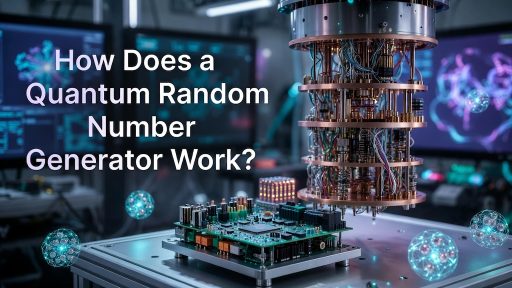
A quantum random number generator produces random numbers by measuring the outcome of quantum physical processes. To understand why this produces genuine randomness, it helps to understand a key principle of quantum mechanics.
The quantum principle behind QRNG
In classical physics, if you know the state of a system precisely enough, you can predict its future behaviour. A coin flip appears random only because we cannot measure every variable affecting it. In principle, the outcome is determined.
Quantum mechanics is different. At the quantum level, certain physical outcomes are not merely difficult to predict. They are fundamentally indeterminate until the moment of measurement. This is not a measurement problem. It is a property of quantum systems described and verified across decades of experimental physics.
A QRNG exploits this property. By measuring a quantum system at the moment of indeterminate outcome, it extracts a result that was not determined before the measurement took place. That result becomes a random bit.
Common quantum sources used in QRNGs
Different types of QRNGs use different quantum physical sources. The most common include:
Photonic sources
Many commercial QRNGs use photons, the fundamental particles of light. A common approach sends a single photon toward a beam splitter, a device that reflects or transmits light with equal probability. The path the photon takes is genuinely undetermined before measurement. The outcome is recorded as a 0 or 1.
Crypta Labs uses a photonic approach in its QRNG hardware, extracting entropy from quantum optical processes to produce high-quality random bit streams.
Quantum vacuum fluctuations
Even in a complete vacuum, quantum mechanics predicts fluctuations in the electromagnetic field. These fluctuations are inherently random and can be measured and converted into random numbers.
Radioactive decay
The timing of radioactive decay events is a quantum process. Early QRNGs used this approach. While less common in modern commercial devices, it remains a valid quantum entropy source.
Phase noise in quantum optical systems
Laser phase noise, driven by quantum spontaneous emission, provides a high-speed source of quantum randomness used in some high-throughput QRNG implementations.
The three stages of a QRNG
Regardless of the quantum source, most QRNGs operate in three stages:
Stage 1: Quantum event generation A quantum physical process is set up and allowed to proceed. The outcome is genuinely undetermined at this point.
Stage 2: Measurement and detection The outcome of the quantum event is measured and recorded as a raw bit or signal value.
Stage 3: Post-processing Raw quantum measurements often contain some bias or correlation due to hardware imperfections. Post-processing, using techniques such as randomness extraction, removes this bias and produces a uniform, high-quality random output.
How output quality is verified
The quality of QRNG output is tested using statistical test suites such as:
- NIST SP 800-22
- Diehard tests
- TestU01
These tests verify that the output has the statistical properties expected of genuine randomness, including uniform distribution, independence between bits, and absence of detectable patterns.
In addition to statistical testing, some QRNGs support real-time health monitoring to detect hardware faults or environmental interference that could degrade output quality.
QRNG output rates
Output speed varies by implementation. Modern photonic QRNGs can produce random bits at rates suitable for enterprise and embedded applications. Speed is influenced by:
- the quantum source and detector
- the post-processing method
- the hardware architecture
For applications requiring both high throughput and certified randomness, hardware design and integration quality are important considerations.
Want to understand the difference between QRNG and PRNG?
See our guide: QRNG vs PRNG
FAQs
Can QRNG be implemented in software?
No. QRNG requires dedicated hardware to measure quantum physical events. Software-only implementations cannot produce quantum randomness.
Does QRNG hardware need to be large or expensive?
Not necessarily. Advances in photonic integration have enabled compact QRNG implementations suitable for embedded and OEM applications.
What is post-processing in QRNG?
Post-processing refers to mathematical techniques applied to raw quantum measurements to remove bias and ensure the output meets randomness quality standards.
How is QRNG output tested?
Using established statistical test suites such as NIST SP 800-22, which verify the uniformity, independence, and unpredictability of the output.
If you are exploring QRNG for a product, system, or OEM integration, see how Crypta Labs applies QRNG in practice at cryptalabs.com